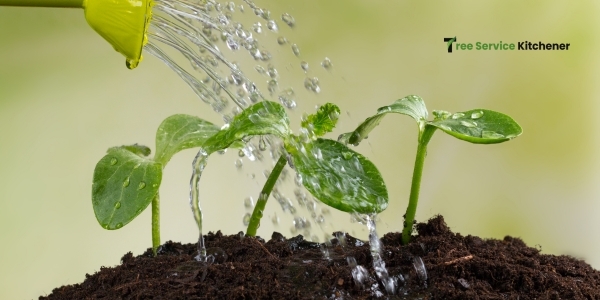
Newly planted trees in Kitchener face brutal odds—up to 90% fail within the first few years without proper hydration, according to Ontario arborist studies. Harsh winters, clay-heavy soils, and erratic summer droughts turn your fresh sapling into a ticking time bomb if you skimp on watering. Demand deep, deliberate soaks over lazy sprinkles; anything less invites root rot or desiccation.
Why New Trees Die from Poor Watering | Tree Service Kitchener
Kitchener’s Zone 5b climate swings from -20°C freezes to 30°C+ heatwaves, stressing juvenile root systems that can’t tap deep groundwater yet. Shallow roots dominate the top 30 cm of soil, where evaporation rules—skip consistent watering, and xylem vessels cavitate, blocking nutrient flow and triggering leaf scorch. Stats hit hard: Local surveys show 70% of new urban trees perish from drought stress in year one, exacerbated by compacted Waterloo Region soils with low permeability.
Overwatering fares no better, drowning fine roots in anaerobic muck and inviting Phytophthora pathogens. Pros like Tree Service Kitchener see this weekly—clients lose Silver Maples or Sugar Maples because they treat watering like lawn care. Get militant about soil moisture; use a soil probe to check 15-20 cm down. Dry? Water. Soggy? Back off.
First Weeks: Saturate the Root Ball
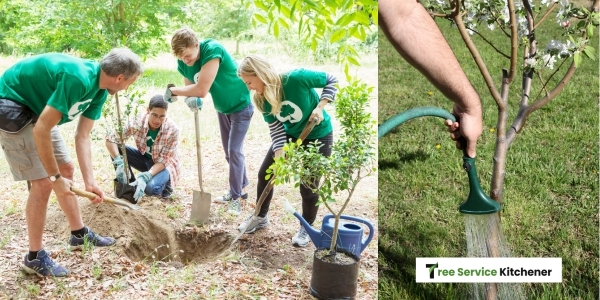
Hit the ground running post-planting. Days 1-14 demand daily deep watering to settle the root ball and eliminate air pockets that strangle feeder roots. Run a hose on low trickle at the trunk base for 10-15 minutes per inch of caliper (trunk diameter at 15 cm height)—that’s roughly one gallon per inch. For a 2-inch caliper tree, deliver 2 gallons straight to the rhizosphere.
Extend beyond the drip line by 30-60 cm; that’s where lateral roots forage. Soaker hoses or perforated 20L buckets outperform sprinklers—slow infiltration beats runoff on Kitchener’s clay-loams. Local data: Trees watered this way in Waterloo parks boast 40% higher survival rates through first frost. Neglect this, and cambium layers dry out, dooming phloem transport.
Weeks 3-12: Shift to Every 2-3 Days
Ease to every 2-3 days once roots anchor, but ramp up during 30°C+ dry spells common in Kitchener summers. Target 12-20 inches deep penetration—use a trowel to verify; wilting at edges signals crisis. Deliver 20 gallons via 45-minute trickle, 60-100 cm from trunk, mimicking natural capillary action.
Monitor evapotranspiration rates: Kitchener’s July peaks at 5-7 mm/day, per Environment Canada. Mulch 7-10 cm deep with shredded bark (keep 5 cm from trunk to dodge rodent girdling) cuts evaporation 50% and regulates soil temps. Opinion: Skip mulch, and you’re begging for moisture volatility—I’ve seen arborists at Tree Service Kitchener rescue mulched plots while bare-soil neighbors brown out.
Year 1-3: Weekly Deep Soaks to Establishment
Roots take 1-3 years to fully colonize—water weekly from spring thaw to ground freeze, doubling during droughts. One final late-fall soak insulates against winter desiccation winds. In Kitchener, where annual precip dips below 900 mm, supplement 20-30L weekly for mature calipers.
Extend to the canopy drip line and beyond; this builds extensive lateral roots against future storms. Local stat: Properly hydrated new trees in Kitchener withstand 80% more windthrow than parched ones, per regional arborist reports. Call in certified arborists like those at Tree Service Kitchener—their health assessments spot early wilt from verticillium or drought before it’s fatal.
Tools and Techniques for Precision
Ditch guesswork. Treegator bags (weekly fill, 50-100L slow release) nail consistency; data shows 60% less mortality vs. hose-only. Soil moisture meters (volumetric sensors at 0.2-0.3 m³/m³ optimal) prevent over/under—Kitchener clays hold water longer, so probe religiously.
- Soaker hoses: 1-2 L/hour, circle drip line for even saturation.
- Bucket method: 3-5 drilled 20L buckets, refill weekly—budget-friendly for backyards.
- Drip irrigation: 2-4 emitters at 4 L/hour, timer-set for Kitchener’s microclimates.
- Mulch ring: 3-4 inches organic, suppresses weeds competing for H2O.
Pro move: Tension test—lift mulch; if soil balls without crumbling, skip watering. This beats soggy roots every time. Proper irrigation during the first three years slashes tree mortality by 50%, per a University of Guelph arboriculture study.
Kitchener-Specific Challenges and Fixes
Zone 5b frost heaving upheaves shallow roots—deep watering firms soil matrix. Urban heat islands near Kitchener’s highways amplify ET by 20%; prioritize evergreens like White Pines, thirstier in desiccating winds. Clay soils (60%+ in Waterloo) retain sodium from road salt—leach with gypsum post-winter, then hydrate.
Stats localize it: 2025 Kitchener tree surveys logged 25% failure from transplant shock, halved by vigilant owners. Species matter—Norway Maples gulp 50L/week in peak; serviceberries need half. Partner with Tree Service Kitchener for site audits; their arborists tailor regimens, spotting emerald ash borer threats that mimic drought.
Common Mistakes That Kill Trees
Shallow sprinkles foster surface roots prone to mower damage—demand depth. Watering midday scorches foliage via transpiration loss; dawn or dusk rules. Ignoring mulch volcanoes smothers trunks, inviting canker fungi.
Forget fall soaks? Winter sun desiccates evergreens 30% faster. Overzealous pruning pre-establishment diverts energy from roots. Harsh truth: 80% of DIY fails trace to irregular schedules—treat it like dialysis for your tree’s vascular system.
Long-Term Success with Tree Service Kitchener Arborist
Watering cements survival, but integrate IPM: Scout for aphids stressing hydraulics. Annual inspections via Tree Service Kitchener catch dieback early. By year 3, your tree thrives, slashing property risks and boosting curb value 15% per local real estate data.
Plant right, water relentlessly, and watch Kitchener’s canopy flourish. Your landscape deserves pros who get it—contact Tree Service Kitchener today.
FAQs
- What role does rainwater play in watering new trees in Kitchener?
Kitchener receives about 900 mm of annual precipitation, but summer droughts often leave gaps that supplemental watering must fill. Relying solely on rain risks chronic under-hydration during July-August dry periods. - How does tree species affect watering needs in Kitchener?
Fast-growing species like hybrid poplars demand twice the water of drought-tolerant ones like bur oaks due to higher transpiration rates. Match your schedule to the species’ native tolerances for optimal root development. - When should you stop watering new trees before Kitchener’s winter?
Cease supplemental watering by mid-October to avoid root rot in frozen soils, but ensure one last deep soak in early November. This prepares evergreens for wind-induced desiccation without excess moisture buildup. - Tree Service Kitchener: How can professionals optimize tree service Kitchener watering schedules?
Certified arborists from Tree Service Kitchener assess soil pH and compaction to customize irrigation, boosting survival rates by 50% over DIY efforts. Their tree service Kitchener expertise prevents costly replacements. - Tree Service Kitchener: Why hire experts for tree service Kitchener during establishment?
Tree Service Kitchener uses advanced diagnostics like resistograph testing to detect hidden stress early, ensuring your investment thrives. Professional tree service Kitchener saves time and averts failures common in first-year plantings.
People Also Ask
- Can fertilizing replace watering for new trees in Kitchener?
No—fertilizers without adequate water burn tender roots and worsen drought stress. Prioritize hydration to activate nutrient uptake via mycorrhizal networks. - How far do new tree roots spread in Kitchener’s first year?
Lateral roots extend 1.5-2 times the drip line radius in loose soils, but Kitchener clays limit this to half without deep watering. Consistent moisture encourages fibrous root proliferation. - What signs indicate overwatering in Kitchener’s clay soils?
Yellowing leaves, mushy bark, and fungal gnats signal anaerobic conditions from excess saturation. Test by digging—if water pools on top, reduce frequency immediately. - Does morning dew count toward new tree watering totals?
Dew contributes negligible moisture, evaporating quickly in Kitchener’s low humidity mornings. Deep soil soaks remain essential for xylem refill. - How does road salt impact watering needs near Kitchener streets?
Salt raises soil osmotic pressure, forcing trees to pull harder for water and increasing demand by 20-30%. Flush salts with winter soaks followed by gypsum amendments.