Protect your valuable trees during development projects with early warning detection and proven prevention strategies. Learn to identify the subtle early signs of construction-related tree stress and discover the protective measures that save mature trees worth thousands of dollars in landscape value.
Introduction
Picture this: You’ve just completed a beautiful home renovation or landscaping project in Kitchener, admiring the results of months of planning and investment. But six months later, you notice your once-magnificent sugar maple developing yellow patches and dropping leaves prematurely. By the following spring, what was once a healthy, valuable tree has become a liability requiring expensive removal. This scenario plays out across Kitchener neighborhoods every year, leaving property owners with damaged landscapes and thousands of dollars in losses that could have been prevented.
Construction and landscaping activities represent the leading cause of urban tree decline, yet most property owners remain unaware of the warning signs until irreversible damage occurs. With Kitchener’s new tree protection bylaws requiring greater accountability for tree preservation during development, understanding these signs has never been more critical—or more legally important.
The good news? Trees send clear distress signals long before they reach the point of no return, and recognizing these early warnings can save both your trees and your wallet. Recent research shows that 73% of construction-damaged trees can recover with proper intervention if stress signs are caught within the first growing season. Tree Service Kitchener has helped hundreds of local property owners navigate construction projects while preserving their valuable mature trees, using proven strategies that protect both immediate investments and long-term property value.
The Hidden Danger: How Construction Silently Destroys Trees
Research from the International Society of Arboriculture shows the critical role of early detection in construction-related tree stress recovery. Understanding why construction kills trees is crucial for recognizing early warning signs that many property owners miss. The damage usually begins underground and remains invisible for months or even years before symptoms appear above ground, making early detection both challenging and critical.
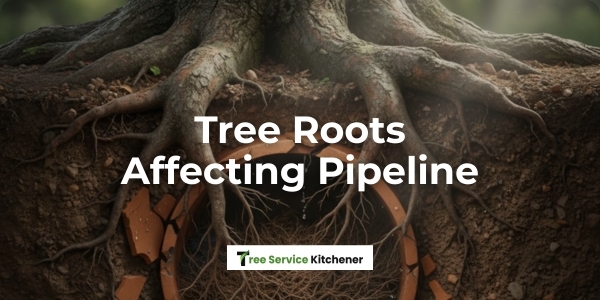
- Root zone destruction is the primary cause. Feeder roots in the top 12-18 inches of soil absorb 90% of water and nutrients. Heavy machinery, excavation, or foot traffic damage these roots, weakening the tree.
- Soil compaction reduces pore space by up to 80%, reducing oxygen and water availability. Kitchener’s dense clay soils worsen this effect, limiting root regeneration.
- Grade changes by adding or removing soil levels can smother roots or expose them, leading to dieback.
- Chemical contamination from fuel spills, concrete washout, and construction materials poisons root zones.
- Delayed response effect means stress symptoms may take years to appear, which can be costly if not caught early.
Early Warning Signs: What Your Trees Are Trying to Tell You
Spotting early symptoms can mean the difference between saving a tree or facing expensive removal.
- Leaf symptoms: Wilted, scorched, or yellowing leaves during moderate weather point to root stress.
- Premature leaf drop indicates the tree is reducing water demand due to damaged roots.
- Growth pattern changes: Smaller leaves, reduced shoot growth, thin canopy, or increased seed/flower production often precede visible decline.
- Branch and twig dieback starts at tip ends and moves inward as stress worsens.
- Bark changes such as vertical cracks, cankers, and epicormic growth signal internal stress or secondary infections.
- Root zone indicators: Look for soil settling or heaving near trees, standing water where drainage was previously good, or mushrooms growing at the tree base—signs of root decay or compaction.
Species-Specific Responses: How Kitchener’s Common Trees React to Stress
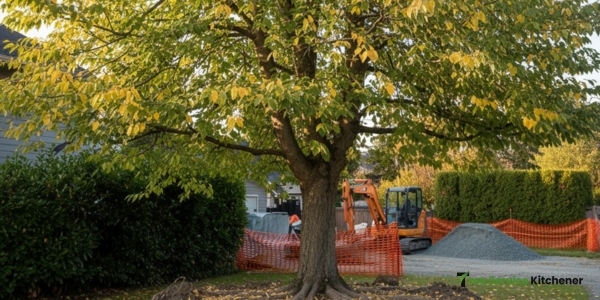
Different species show distinct stress signs to help predict recovery chances.
- Sugar maples show rapid leaf yellowing starting at branch tips and crown dieback. Recovery needs 2-3 years of care, but mature trees can add $10,000 to $15,000 in property value.
- Red oaks maintain foliage for 1-2 years after damage but then decline quickly. Symptoms include less acorn production, smaller leaves, and subtle crown thinning.
- Eastern white pine and other conifers show needle yellowing, premature needle drop, and reduced new growth, often requiring removal in 2-3 years.
- Norway maples often produce excessive suckers and exhibit leaf scorch but are somewhat more resilient.
- Ash trees are vulnerable to emerald ash borer, with stress leading to dieback and bark splitting. Removal is often necessary to prevent pest spread.
- Birch species may suffer from bark damage and canopy thinning, with attacks by bronze birch borer worsening the decline.
Fast-growing species like willow may recover quickly, while slow growers like oak need long-term monitoring.
Prevention Strategies: Protecting Trees Before Construction Begins
Preventing damage is more effective and economical than treatment.
- Pre-construction tree assessment by arborists defines tree health and value to prioritize protection.
- Construction zone planning sets root protection zones based on trunk diameter to limit soil disturbance.
- Physical protection barriers such as fencing and signage secure critical root areas.
- Soil protection measures involve mats and barrier placement to avoid compaction.
- Utility coordination avoids root severance from underground utility digging.
- Monitoring and maintenance during construction ensures early detection of stress and prompt care like watering and soil testing.
Recovery and Treatment: Saving Stressed Trees
If damage occurs, early intervention can help.
- Immediate responses in the first 1-2 months involve deep watering, mulching, pruning damaged branches, and temporary shading.
- Soil rehabilitation using decompaction and amendments restores root health.
- Root system restoration includes fertilization, mycorrhizal inoculants, and possibly root pruning.
- Canopy management with selective pruning reduces water demand and wind stress.
- Long-term care programs extend 2-5 years with monitoring, supplemental watering, and pest control.
- Success monitoring tracks regrowth and helps decide if removal is needed.
Tree Service Kitchener
Recognizing early construction-related stress signs can save mature trees and thousands of replacement dollars. Since damage often starts underground and may emerge years later, prevention and early intervention are key. Consult Tree Service Kitchener’s certified arborists to protect your landscape investment during construction projects.
Protect your Kitchener property investment by contacting Tree Service Kitchener today for a professional tree health assessment and expert construction project support.
FAQs
- How does Tree Service Kitchener help prevent construction tree stress?
Tree Service Kitchener performs pre-construction assessments, sets protective zones, and coordinates with contractors to minimize root damage, ensuring healthier trees post-development. - What signs indicate urgent professional tree care after construction?
Premature leaf yellowing, leaf drop, twig dieback, and soil changes near trees after construction are urgent signs needing immediate arborist intervention. - Can a mature sugar maple fully recover from root damage during construction?
With early detection and intensive care over several growing seasons, sugar maples can recover, preserving significant landscape value. - Does soil compaction permanently damage tree roots?
Compaction severely limits oxygen and water uptake, but soil decompaction and amendments can restore root zone health if treated promptly. - Why is it important to monitor trees long-term after construction?
Delayed symptoms often appear years later; ongoing monitoring ensures timely treatments to prevent irreversible damage.
People Also Ask
- How long does it take for construction damage to show in trees?
Symptoms may appear from months to several years post-construction, depending on species and damage severity. - Are some tree species more resistant to construction damage?
Yes, urban-adapted species like Norway maple tend to be more resilient, while species like oak and pine are more sensitive. - What role do soil microorganisms play in tree recovery?
Beneficial microbes like mycorrhizae support nutrient uptake and root regeneration, improving stressed tree recovery. - Can construction fencing alone protect tree roots?
Fencing helps but must be combined with soil protection and restricted equipment access for full effectiveness. - How does Tree Service Kitchener evaluate tree preservation value?
They assess health, species, size, and landscape impact to prioritize protection and advise on preservation versus removal.
Tags: tree stress Kitchener, construction tree damage, tree care Kitchener, tree preservation construction, arborist Kitchener